14 August 2026 — Pakistan Independence Day (Friday Holiday)
14 August 2026 is Pakistan’s Independence Day — Youm-e-Azadi (یومِ آزادی). It falls on a Friday and marks the 79th anniversary of independence from British rule on 14 August 1947. It is a national public holiday across Pakistan, observed as Jashn-e-Azadi in every province, Islamabad, Azad Jammu and Kashmir, and Gilgit-Baltistan. For students, the same weeks carry a second kind of anticipation, as most educational boards announce their results around this period. Students and families can check your 9th class result 2026 online, turning a season of national celebration into a personal milestone for thousands of families.
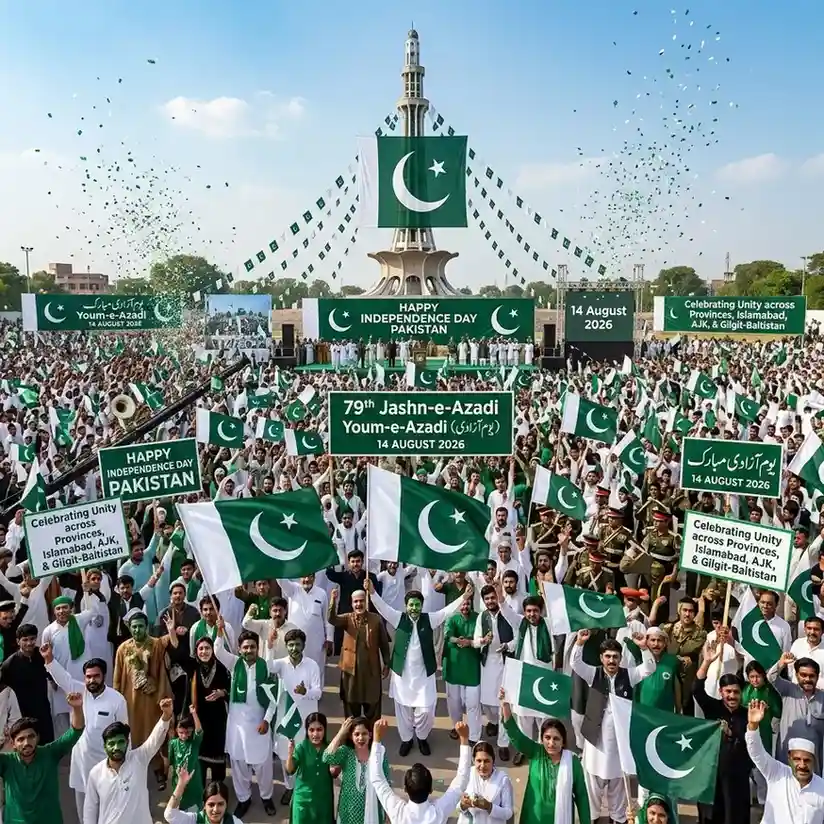
کتنے دن باقی ہیں — Countdown to 14 August 2026
جشنِ آزادی 2026 — Countdown to 14 August
Loading countdown…
Counting down to 12:00 AM, Friday 14 August 2026 (Pakistan Standard Time).
14 August 2026 falls on a Friday. It is the 226th day of the year, the 33rd Friday of 2026, and sits in ISO week 33, with 139 days remaining in the calendar year. The date never moves — Independence Day is fixed to 14 August, so the countdown above resets to 2027 the moment this year's celebrations close.
Is 14 August 2026 a Public Holiday? (And Do You Get Saturday Off?)
Yes. 14 August is a gazetted national public holiday, listed in the Cabinet Division's official public holidays notification for 2026. Federal and provincial government offices close, as do courts, schools and banks.
The Saturday question is where people actually get confused, and the honest answer is that it depends on your employer's working week.
- Five-day week (Monday to Friday). Friday 14 August is your holiday, and Saturday and Sunday follow as your normal weekly off days. That gives you three consecutive days — the long weekend most people are counting on.
- Six-day week (Monday to Saturday). Friday is off, then you are back at work on Saturday 15 August. No three-day break.
There is no rule that pushes a Friday holiday into Saturday. When a public holiday lands on a Friday, Saturday stays a working day unless your organisation already treats it as an off day. Some employers with Friday–Saturday weekends grant the preceding Thursday instead, but that is a company decision, not a government one.
What Closes, and What Does Not
- Government offices. Closed nationwide, federal and provincial.
- Schools and colleges. Closed. Institutions on a Monday–Friday timetable resume Monday 17 August; those running Monday–Saturday resume on the 15th.
- Private employers. A gazetted holiday applies to establishments covered under provincial factories and shops legislation, and workers required to attend are generally entitled to compensatory leave or holiday pay. Practice varies across sectors — check your appointment letter or HR policy rather than assuming.
- Shops, markets and transport. Fully open. The 13th and 14th are among the busiest retail nights of the year.
Bank Holiday Status
Banks close for public dealing on 14 August. Branches carry out internal operations only, so no counter service, no cash deposits or withdrawals, and no cheque clearing that day. ATMs, mobile banking apps, internet banking and Raast transfers continue running normally. Clearing resumes on the next working day, which for most banks means Monday 17 August.
What Happens on 14 August 2026 — Ceremonies, Timings and Gun Salutes
The day follows a settled national pattern. Here is the sequence, from dawn to fireworks.
ISPR usually releases its annual milli naghma in the days before the 14th. This year's release had not been announced at the time of writing.
Where to Watch — City-by-City Celebrations
One thing worth knowing before you plan anything: the streets do not wait for the 14th. Celebrations start on the nights of 12 and 13 August, and in most cities the loudest night is the 13th, when families come out after Isha and the roads fill until well past midnight.
Islamabad. The main fireworks display is staged at the Shakarparian Hills amphitheatre and is visible across much of the city, so you do not need to be inside the venue. The Pakistan Monument and Constitution Avenue are the focal points for daytime ceremonies. Expect road closures around the Red Zone.
Lahore. The Mall Road parade runs through the morning, and Minar-e-Pakistan is fully illuminated on the eve of Independence Day. Celebrations spill into the Walled City lanes around Bhati and Delhi Gate and continue past midnight. Liberty and Gulberg get heavy traffic from the 12th onward.
Karachi. Mazar-e-Quaid is the centre of the day — flag hoisting, change of guard and wreath-laying, with crowds arriving from early morning. Fireworks are held near the National Stadium in the evening. Sea View and Do Darya draw large family crowds on the night of the 13th.
Peshawar, Quetta, Multan and Faisalabad. Provincial and district flag-hoisting ceremonies are held at governor houses, commissioner offices and civic squares, followed by student parades and evening illumination of government buildings. In Multan, where homes, shops and bazaars go all-out with strings of lights for the occasion, the extra usage tends to show up on the next mepco bill, so many households keep an eye on their meter through the festival days.
Wagah border, Lahore. The flag ceremony draws its largest crowd of the year on 14 August, and Pakistani paramilitary troops have traditionally exchanged sweets with their counterparts across the gate. Arrive early — seating fills hours ahead.
Why 14 August? The Story of 1947
The demand that produced Pakistan took shape over roughly four decades, and it did not begin with a call for a separate country.
The All-India Muslim League was founded in Dhaka in 1906 to represent Muslim political interests within British India. Muhammad Ali Jinnah joined in 1913 and for years worked toward Hindu-Muslim cooperation inside a united India — he was the architect of the 1916 Lucknow Pact between the League and the Indian National Congress. The shift toward a separate state came later, and gradually.
In December 1930, at the League's annual session in Allahabad, Allama Iqbal argued for the consolidation of the Muslim-majority provinces of north-west India into a single self-governing unit. He did not use the word Pakistan. That name appeared in 1933, in a pamphlet titled Now or Never circulated at Cambridge by Choudhry Rahmat Ali, assembled from the letters of Punjab, Afghania, Kashmir, Sindh and Balochistan.
The decisive moment came on 23 March 1940 at Minto Park in Lahore, where the League passed what became known as the Lahore Resolution, or Qarardad-e-Pakistan. It called for independent states in the Muslim-majority regions of north-western and eastern India. The site is now marked by Minar-e-Pakistan.
The end came quickly after the Second World War. In February 1947, British Prime Minister Clement Attlee announced that Britain would transfer power in India by June 1948 at the latest. Lord Mountbatten arrived as the last Viceroy in March and accelerated the timetable. On 3 June 1947, the British government confirmed that partition into two dominions had been accepted. The Indian Independence Act received royal assent on 18 July.
The border itself was drawn in five weeks. Cyril Radcliffe, a British barrister who had never visited India, chaired the Boundary Commissions dividing Punjab and Bengal. The Radcliffe Line was not published until 17 August — three days after independence — leaving millions uncertain which country they had woken up in.
What followed was among the largest forced migrations in recorded history. Academic estimates of displacement across the subcontinent range from 12 to 20 million people, and the Harvard study led by Jennifer Leaning puts the figure above 18 million. Estimates of deaths vary widely, from 200,000 to two million, with most historians settling somewhere near a million. Punjab suffered worst. Muslims, Hindus and Sikhs were killed in comparable horror on both sides of the new line, and roughly 50,000 women were abducted.
Pakistan began as a state with a borrowed administration and no treasury. Karachi was the first capital. Jinnah served as Governor-General until his death in September 1948; Liaquat Ali Khan was the first Prime Minister; Fatima Jinnah worked alongside her brother throughout. The country marks 14 August as the day that state came into being.
Why Pakistan Celebrates a Day Before India
The two dates come from one piece of scheduling.
Mountbatten intended to attend both independence ceremonies, and he could only do that if they were held on consecutive days. He travelled to Karachi on 13 August, addressed the Constituent Assembly of Pakistan on the morning of 14 August, delivered King George VI's message and formally transferred power. He then flew back to Delhi for India's transfer at midnight on 14–15 August.
Here is the part most pages leave out. The Indian Independence Act 1947 named the same date for both countries: "As from the fifteenth day of August, nineteen hundred and forty-seven, two independent Dominions shall be set up." In his first broadcast to the nation, Jinnah himself described 15 August as the birthday of Pakistan. The 14th settled into national practice afterwards.
One detail is genuinely disputed. Popular reference sources state that Jinnah was sworn in as Governor-General on 14 August. The academic record disagrees: the Pakistan Journal of History and Culture, published by the National Institute of Historical and Cultural Research, records that Jinnah was formally sworn in on 15 August 1947 by Sir Abdur Rashid, Chief Justice of the Lahore High Court, with Liaquat Ali Khan's cabinet taking oath the same day. We follow the academic source. The 14 August ceremony was the transfer of power; the oath came after.
Facts Most People Don't Know About 14 August 1947
The Flag—Sabz Hilali Parcham
The Constituent Assembly adopted the national flag on 11 August 1947, on a resolution moved by Liaquat Ali Khan. It became the flag of the Dominion of Pakistan on the 14th.
Syed Amir-uddin Kedwaii, a lawyer and Muslim League member, designed it by adapting the All-India Muslim League's green banner. His change was the white vertical stripe at the hoist, added to represent Pakistan's non-Muslim citizens. The first physical flag was stitched by a craftsman named Master Afzal Hussain.
- What each element means. The dark green field represents the Muslim majority. The white stripe at the hoist represents religious minorities. The crescent stands for progress, the five-pointed star for light and knowledge. The national anthem refers to it as Parcham-e-Sitara-o-Hilal.
- Correct proportions. The flag is 2:3 in height to width. The green field occupies three-quarters of the length and the white stripe one-quarter. The crescent and star sit centred within the green portion. A flag with a narrow decorative stripe, or none at all, is not the national flag — the stripe is a quarter of the flag by design, and shrinking it removes the meaning.
- Etiquette that actually matters. Display is governed by the Pakistan Flag Rules, 2002. Hoist it briskly in the morning and lower it slowly before sunset. Do not fly it after dark unless it is properly illuminated. Never let it touch the ground, and never use it as clothing, table covering, or wrapping. A torn, faded or dirty flag should be replaced, not flown — worn flags are disposed of privately and respectfully rather than discarded in public rubbish. On days of national mourning it flies at half-mast; on 14 August and 23 March it flies at full mast. When displayed alongside other national flags, it is not flown lower than any of them.
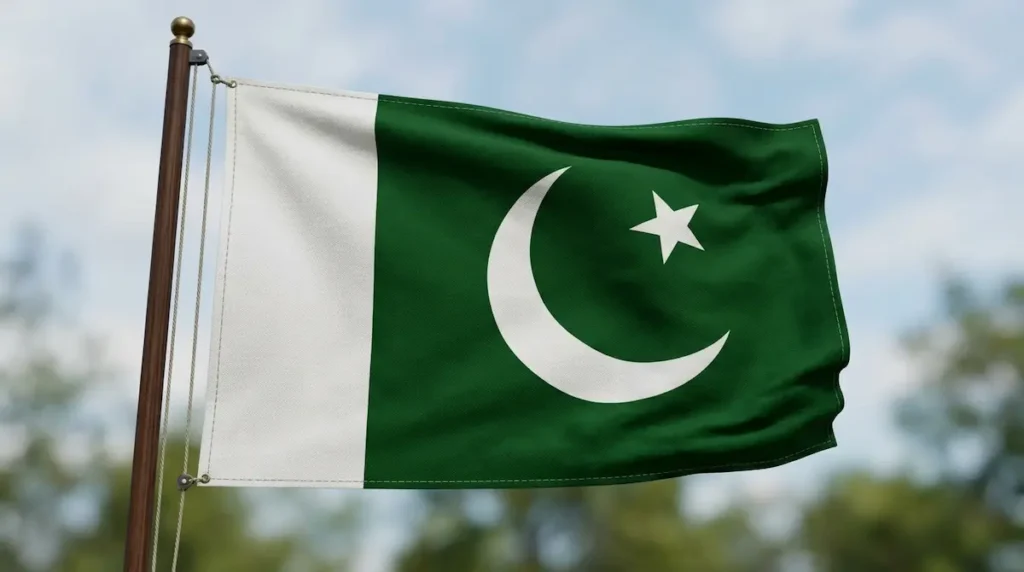
Schools and offices hoisting a flag on the 14th should check one thing above all: that the white stripe is on the hoist side, nearest the pole. A reversed flag is the most common mistake of the day.
Milli Naghmay — The Songs of 14 August
The national songs are not background. For most Pakistanis they are the sound of the fortnight, and several of them are older than the people singing along.
For listening, use the official YouTube channels — PTV, ISPR, EMI Pakistan and the artists' own — rather than re-uploads. The audio is better and the credits are correct. Our full milli naghmay list has the year, composer and lyricist for each one.
For Schools and Students
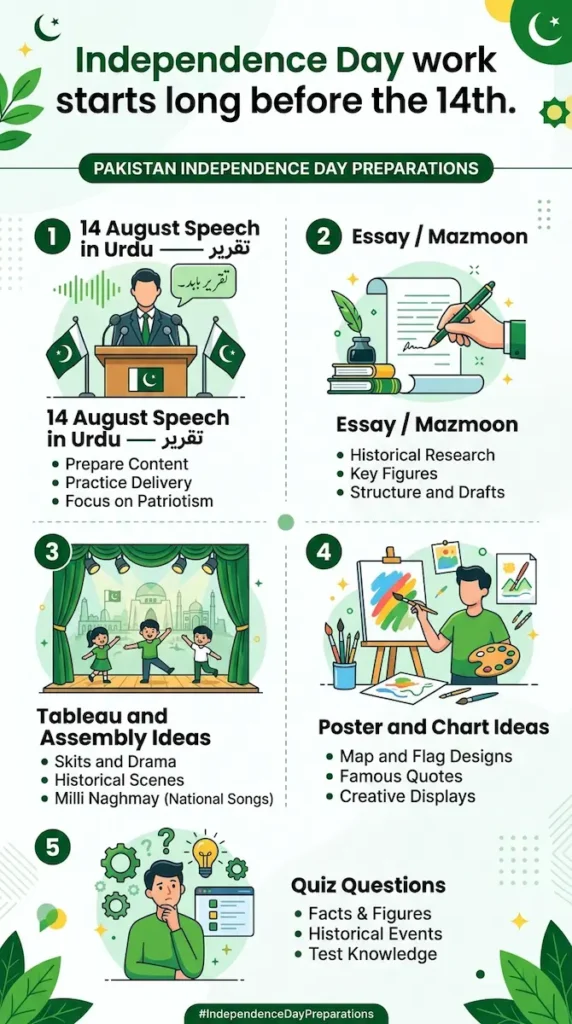
Independence Day work starts long before the 14th. Assemblies are rehearsed from the first week of August, and most of what teachers and students need is a finished thing they can use, not advice about making one. Each page below contains the actual material.
14 August Speech in Urdu — تقریر
Two complete speeches, ready to read. A two-minute taqreer for primary classes in simple Urdu, and a five-minute version for secondary students covering the Pakistan Movement, the Lahore Resolution and the responsibilities of independence. Both are given in Urdu script with Roman Urdu underneath, so a student who reads Urdu slowly can still deliver it confidently. Read More: 14 August Speech in Urdu
Essay / Mazmoon
A full-length essay on Youm-e-Azadi in Urdu and a matching English version, each structured with a clear introduction, historical background, significance and conclusion. Written at two difficulty levels for middle and matric students, with a paragraph outline you can rearrange if your teacher has set a specific word count or heading structure.
Tableau and Assembly Ideas
Workable concepts for a school tableau, with a running order for the whole assembly — flag hoisting, national anthem, tilawat, speech, naghma, tableau, closing dua. Includes song suggestions matched to age group, staging notes for a small hall, and realistic timing so the programme finishes before the morning heat sets in.
Poster and Chart Ideas
Layouts for chart paper and printed posters, with the correct flag proportions, the official green shade, and colour pairings that photograph well. Includes headline suggestions in Urdu and English, spacing guidance, and downloadable templates you can print or trace directly onto chart paper.
Quiz Questions
Twenty questions with answers, covering 1947, the Pakistan Movement, national symbols and the founders — graded from easy to hard so one set works for a whole school. Suitable for classroom rounds, assembly competitions or a written worksheet. Answer key included separately so you can print the questions alone.
Wishes, Status and DP for 14 August
Most people looking for this arrive on a phone, want something to send in under ten seconds, and leave. So this section is built around tapping, not reading.
- Wishes and messages — short greetings in Urdu, Roman Urdu and English, each with a copy button. Azadi Mubarak, Jashn-e-Azadi Mubarak, Happy Independence Day, plus longer messages for family WhatsApp groups, office broadcasts and school cards. Pick one from the ready-to-send wishes and tap Copy.
- Poetry — the shayari space is saturated with the same couplets copied across hundreds of sites, so we do not republish them. What you will find here is original verse written for this site, and classical work that is out of copyright, quoted with the poet's name attached. Iqbal gets attributed to Iqbal.
WhatsApp status and DP frames — square and vertical formats sized correctly for WhatsApp, Instagram and Facebook, so nothing gets cropped. Name frames render in the browser; no app install. Make your DP now with our 14 August Name DP Maker.
Wallpaper pack — free download, phone and desktop sizes, green and white with the flag in correct proportions.
What to Wear and How to Decorate
- On stitching, plainly: if you are reading this in August, the window has closed. Tailors across Pakistan take Azadi orders through July and are booked solid by the first week of the month. Anything unstitched you buy now will not be ready by the 14th. Plan a stitched suit for next year in early July, or skip it this year.
- What still works. Ready-to-wear kurtas and shirts in green or white, roughly Rs 1,500–4,500 depending on brand and fabric. Green dupattas and stoles from Rs 500. White kurta with a green dupatta is the simplest combination that reads as Azadi without needing a tailor.
- Accessories carry the look. Badges Rs 20–60, wristbands and hairbands Rs 50–150, face paint sticks, green bangles, flag pins. For children, a plain white shirt plus a badge and a hand flag does the job.
- Decoration. Hand flags Rs 20–50, car flags Rs 100–250, large hoisting flags in 3×2 ft from around Rs 400, bunting strings and jhandiyan Rs 100–350, balloon sets, and fairy lights from roughly Rs 600. Prices climb through the 12th and 13th as street stalls sense the deadline, so buy early in the week.
Ranges are typical retail across major cities and vary by market, brand and quality — Ichra and Anarkali in Lahore, Jodia Bazaar in Karachi, and Raja Bazaar in Rawalpindi run well below mall pricing. See the full price list and markets before you head out.
14 August and Pakistan's Other National Days
| Day | Date | What it marks |
|---|---|---|
| Youm-e-Istehsaal | 5 August | Kashmir solidarity observance |
| Minorities Day | 11 August | Jinnah's 11 August 1947 address to the Constituent Assembly |
| Independence Day | 14 August | Independence in 1947 |
| Defence Day | 6 September | Youm-e-Difa, the 1965 war |
| Iqbal Day | 9 November | Allama Iqbal's birth |
| Quaid-e-Azam Day | 25 December | Jinnah's birth |
| Pakistan Day | 23 March | Lahore Resolution, 1940 |
August carries three of these within ten days. Youm-e-Istehsaal on the 5th appears in the Cabinet Division's own 2026 calendar, and Minorities Day on the 11th marks the speech most often quoted on the 14th.
Frequently Asked Questions
Is 14 August 2026 a public holiday in Pakistan?
Yes — a gazetted national public holiday listed in the Cabinet Division's 2026 notification. Government offices, courts, schools and banks close nationwide. Shops, markets and transport operate normally, and the 13th and 14th are among the busiest retail nights of the year.
Is Saturday 15 August also a holiday?
Only if your organisation already treats Saturday as an off day. Five-day-week offices and Monday-to-Friday schools get three consecutive days. Six-day-week workplaces return on Saturday 15 August. A Friday public holiday does not carry over into Saturday automatically.
What day of the week is 14 August 2026?
Friday. It is the 226th day of the year and falls in ISO week 33, with 139 days remaining in 2026. The date itself never changes — Independence Day is fixed to 14 August regardless of which weekday it lands on.
Which anniversary is 14 August 2026?
The 79th. Pakistan became a sovereign state on 14 August 1947, so 2026 marks seventy-nine years of independence. The 80th anniversary falls in 2027, and the centenary in 2047.
14 August ko kya hai?
Youm-e-Azadi — Pakistan ka Independence Day. 2026 mein yeh Friday ko hai aur 79th anniversary hai. Poore mulk mein public holiday hoti hai, aur celebrations 12–13 August ki raat se shuru ho jati hain.
Why does Pakistan celebrate on 14 August and India on 15 August?
Mountbatten wanted to attend both ceremonies, so he transferred power in Karachi on 14 August and flew to Delhi for India's midnight ceremony. The Indian Independence Act 1947 actually named 15 August for both dominions; the 14th settled into Pakistani practice afterwards.
How many days are left until 14 August 2026?
The live countdown at the top of this page shows days, weeks, hours and minutes, locked to Pakistan Standard Time so the number reads the same from Lahore, Dubai or Toronto. It rolls to 2027 automatically once this year's celebrations close.
What time is the flag hoisting ceremony?
In Islamabad, a siren sounds at 9:59 am and traffic stops for one minute, followed by flag hoisting and the national anthem. Provincial, divisional and district ceremonies run through the morning. The exact 2026 broadcast schedule has not yet been announced.
Are banks open on 14 August?
Closed for public dealing. No counter service, cash transactions or cheque clearing. ATMs, mobile banking, internet banking and Raast transfers keep working. Clearing resumes the next working day, which for most banks means Monday 17 August.
How many gun salutes are fired on Independence Day?
A 31-gun salute in the federal capital and a 21-gun salute in each provincial capital, fired at dawn to open the official ceremonies. The same salute pattern is used on Pakistan Day, 23 March.